Welcome!

Welcome to the Ard-Knox Insurance Blog.

We will bring you Art related and Art Insurance related news and information we believe is of interest to our clients and friends.

Please feel free to notify us of any news you might have that we can share with our readers.

Thank you.

Sunday, May 15, 2011

Recycle Runway Lands in the Atlanta Airport

Recycle Runway Lands in the Atlanta Airport! Published: 05.10.2011 at 11:20 am by Nancy Judd
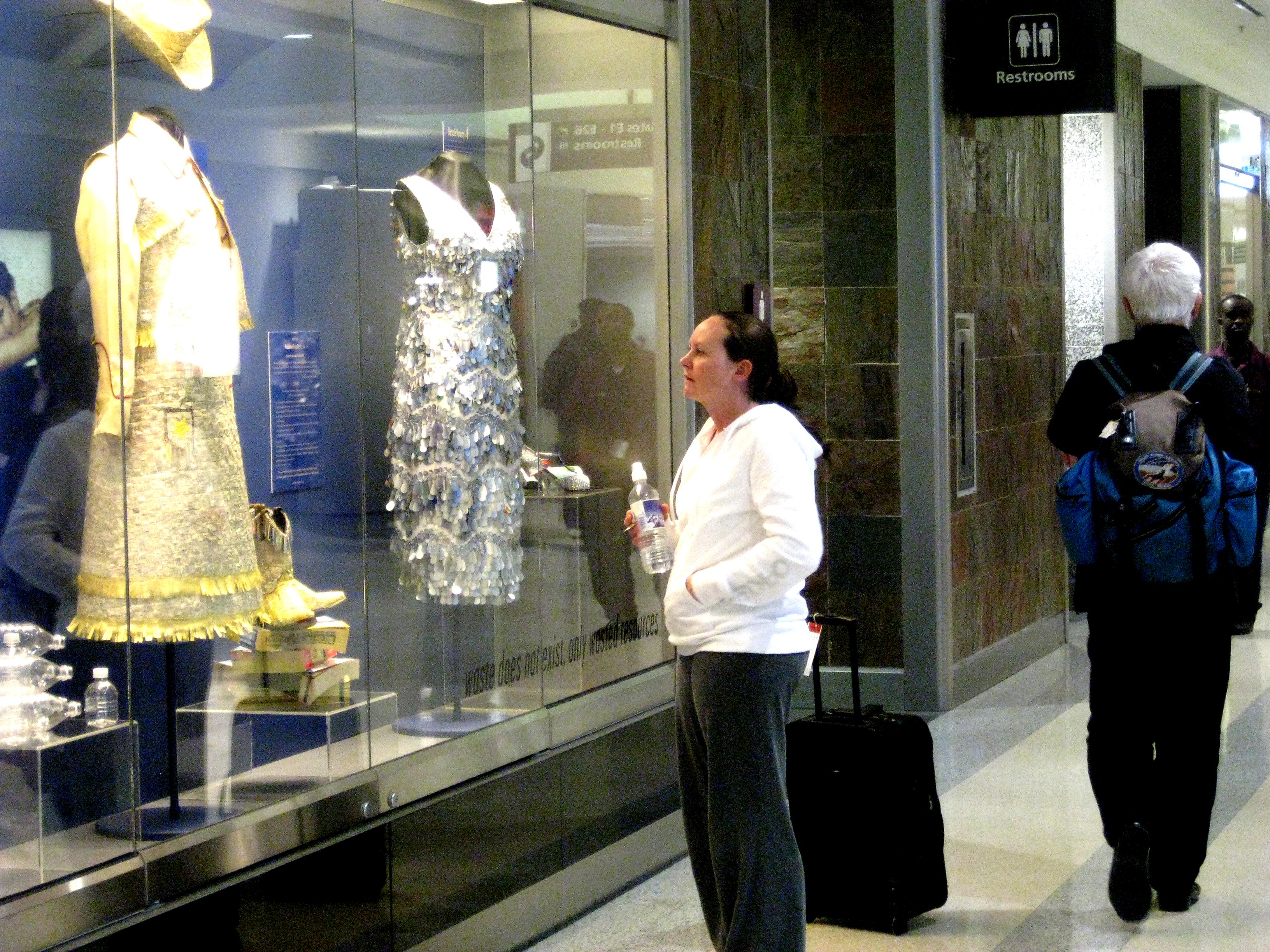
Recycle Runway Exhibition in the Atlanta Airport
The dust has settled from my two week adventure in Atlanta installing the Recycle Runway exhibition, “waste does not exist, only wasted resources.” I have returned, finished up some minor details and gotten some well needed rest.
After three years of preparations, eighteen of my recycled fashion designs are now on display in nine cases throughout International Concourse E. To access Concourse E take the “Plane Train” (AKA the Concourse Shuttle) or just walk from any one of the concourses or the main terminal. (Note to Atlanta residents: Concourse E is on the secure side of the airport, so you will need a ticket to get there.)
I started the first week with a presentation on resources to some students at the International School in Atlanta sponsored by Novelis. Whenever I go somewhere to install an exhibition or make a new garment I like to give school presentations and working with kids is always a thrill – their minds are so fresh and innovative I always end up learning from them.
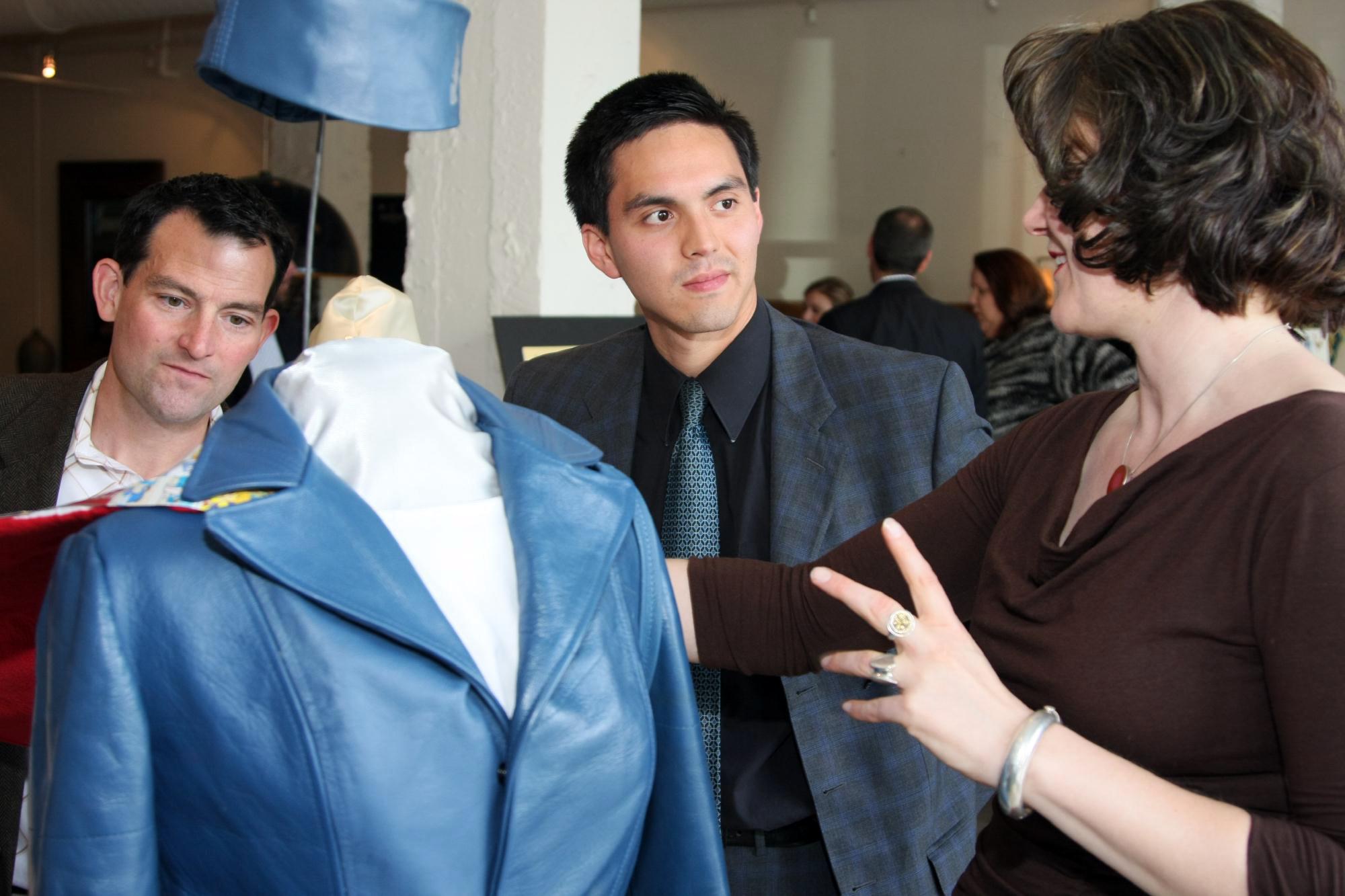
Introducing the Environmental Steward-ess to my sponsors, Frank and Aaron from Delta Air Lines!
On Wednesday we held a big launch party for my show at a sustainable furniture company called “Environment”. I had arranged a number of my garments, including Delta’s new Environmental Steward-ess, amid the furniture made from reclaimed, recycled, and sustainably harvested wood, so all night guests were weaving in and out of the display – truly a visually interesting mix! Approximately 50 people turned up including the press, some of my sponsors, local designers and artists, community environmental activists and even a few friends. But the best part of all was finally meeting some of the people that are sponsoring this exhibition and supporting my work.
I spent the rest of first week meeting Katherine and David from the Airport Art program, settling preliminaries like which size and style of pedestals to use in the airport art cases, and returning in the evenings to my vacation rental to prepare and eat the chard I had smuggled on the plane. For those of you who are interested, chard travels well.
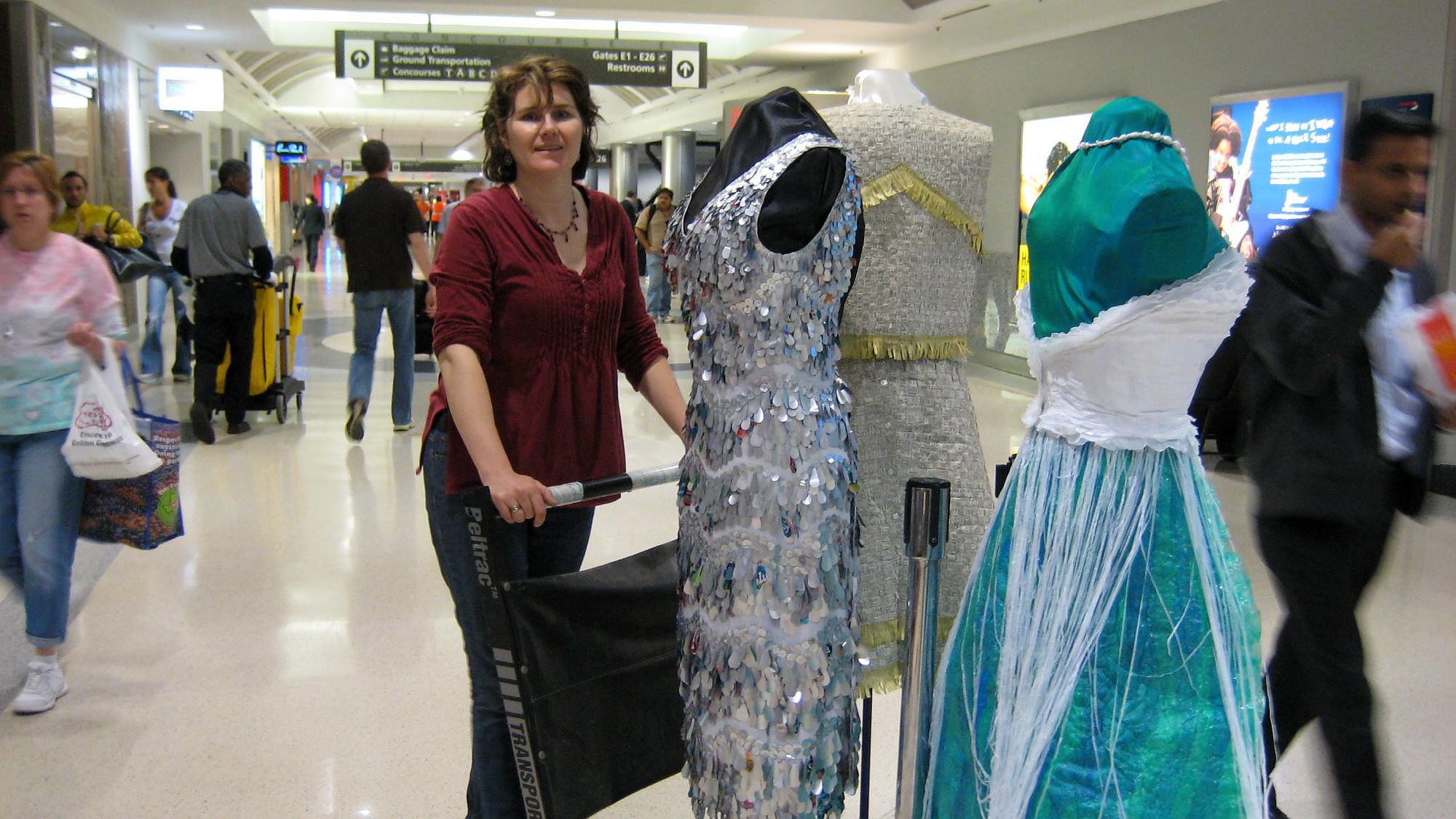
Transporting the Dresses Through the Concourse
I had no idea what I had really signed up for in the second week when we finally began installing the show! Nothing can prepare you for working in an airport. It is so very different from being in one for travel only. You really have no idea how dazed people are in new, large and busy surroundings, trying to keep track of their luggage and keep their families together. I felt as though I got a fresh peek at what I must look like traveling thither and yon.
I had agreed to do the installation between 7 PM and 4 AM so we came in for work while the airport was still hopping and within the next couple of hours would begin winding down for the day. Yes, the
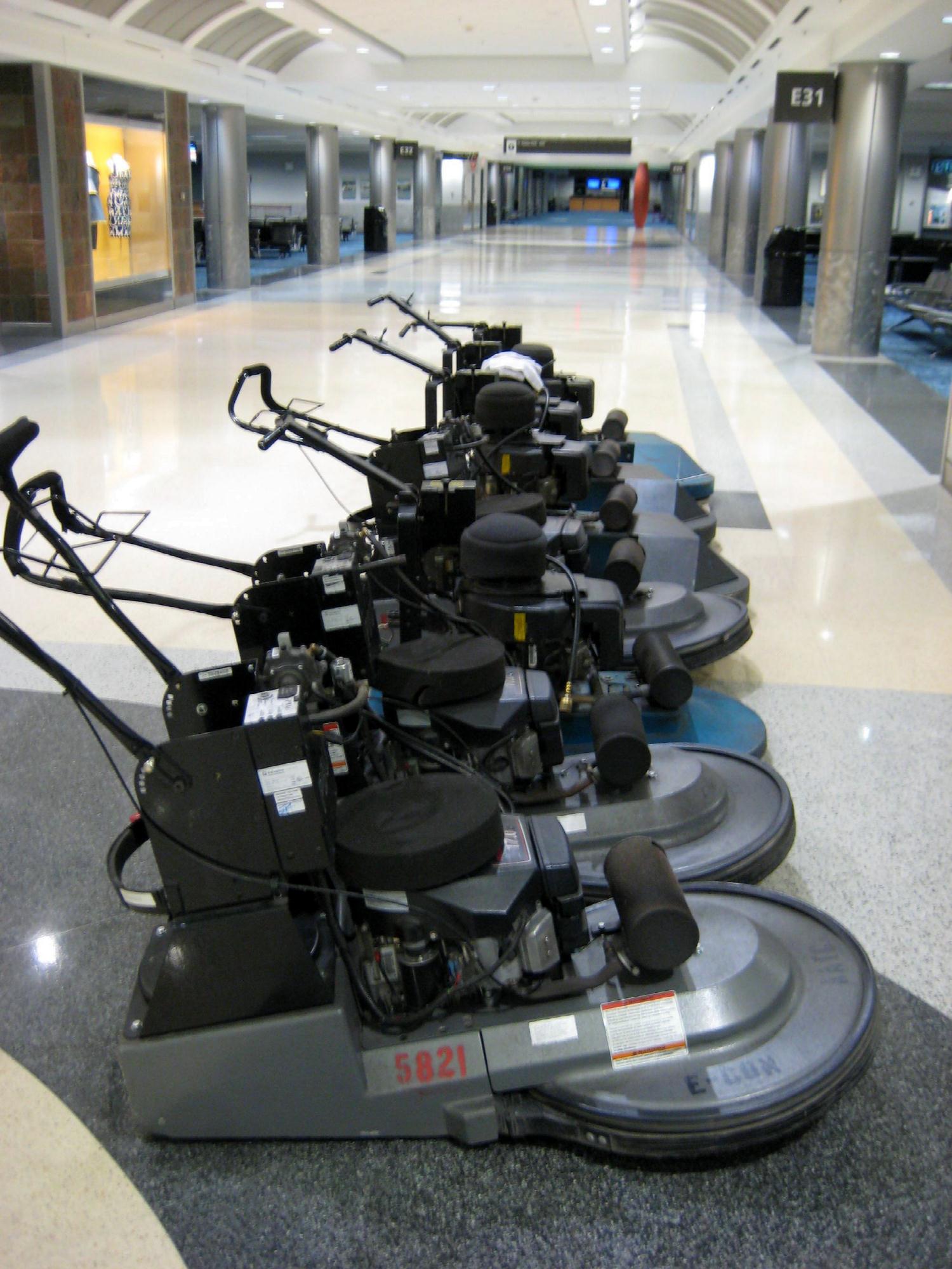
Floor Polishing Equipment
Hartsfield-Jackson Atlanta International Airport actually closes down somewhere between 11 and midnight and the empty halls begin to fill will all kinds of cleaning apparatus and work relations banter. Imagine the number of night staff you have to have to maintain the busiest airport in the world!
Inside the halls of Concourse E Katherine and David trekked vast distances from case to case, applying vinyl lettering and information placards while I and the fourth member of our team, Nicole, spent hours and hours locked in a windowless room filled with my dress forms and garments and a wide variety of other art installation materials. It began to get a little surreal as I unboxed the pieces and prepped the garments for their “in case” debut but I was eventually grateful that I couldn’t really tell what time it was and I was so busy I didn’t care. Our little team was actually fighting to get the installation done within the time we were given – 3 nights.
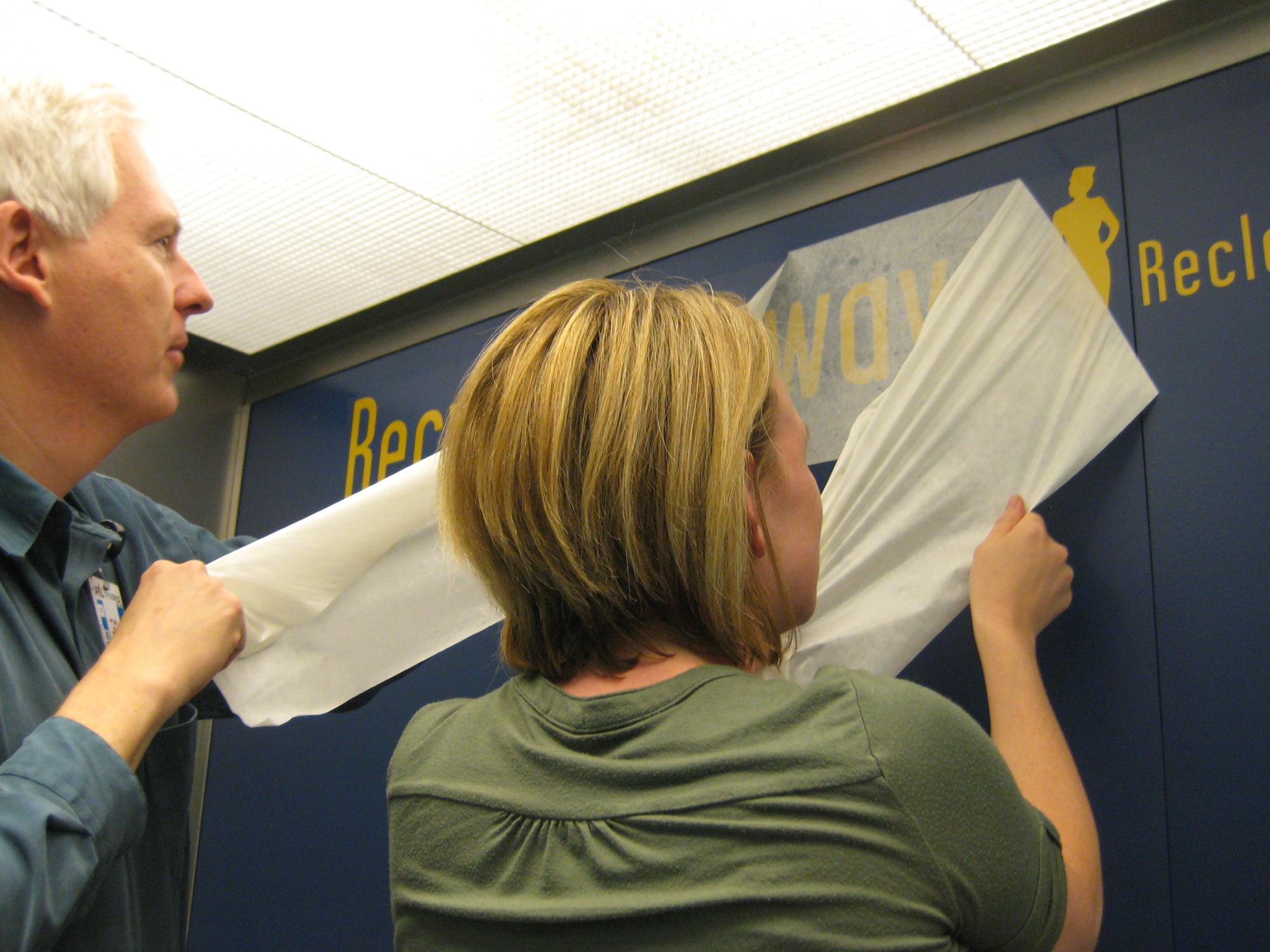
David and Katherine Applying the Vinyl Exhibition Titles
Applying the Vinyl Exhibition Titles
The amazing and very sweet compliments of the night staff kept us going as we pushed dollies full of dresses throughout the concourse. Bleary eyed we’d exit every morning at 5 AM heading back home to sleep, eat and take a nap before doing it all over again. We squeezed every last minute out of our allotted time and in the end everything just fell together. It was a truly inspiring piece of team work and I am so thankful to all those that helped!
This exhibition would not be possible without the support of my case sponsors: Coca-Cola, Delta Air Lines, Janome, and Novelis and my Green Partners: Earth911.com, the Georgia Chapter of the Sierra Club, the Georgia Recycling Coalition, Keep America Beautiful, Keep Georgia Beautiful, the Phoenix Airport Museum and the Turner Foundation. And of coarse thank you to my host, Atlanta’s Airport Art Program! It is such an honor to be part of their impressive group of permanent and rotating art exhibitions! If you have been through this airport before you are sure to have noticed all the great art…my favorite of the permanent collections are the Zimbabwe sculptures in the walkway between Concourse T and A.
Thus far the exhibition has received great press, in the last couple of weeks articles have appeared on the front pages of cnn.com and yahoo.com. I have received so many encouraging e-mails from all over the world!
Well, as mentioned, I did have a few details to iron out when I got home. There is a short video presentation on the show and my work that CNN will run throughout the airport for the entire year the pieces are on display but we have had a hard time finding the requested digibeta tape. RESOURCE RE-THOUGHT Number 1 – The terrible earthquake and tsunami from March 11 that devastated Japan has also taken its toll on many of the electronic resources for the entire world. The reason that the digibeta tape has been so hard to get is that most of the manufacturing of these tapes is done in Japan. Where do your resources come from?

Monday, May 9, 2011

Flood Insurance - Affordable and Needed

Flood Season is on us!

According to the National Weather Service, Americans live in one of the most severe weather-prone countries on Earth. Each year Americans cope with an average of 10,000 thunderstorms, 5,000 floods, 1,000 tornadoes, and an average of 2 land-falling deadly hurricanes. And this is on top of winter storms, spring snow melting and intense summer heat, high winds, wild fires and other deadly weather impacts.


The Colorado State University's (CSU) Tropical Meteorology Project has issued their April forecast which calls for a busy 2011 season. The CSU team is predicting approximately 16 named storms, 9 hurricanes, 5 of which will be "major" hurricanes of category 3 or higher. Colorado State University hurricane researchers Philip Klotzbach and William Gray anticipate “an above-average probability of United States and Caribbean major hurricane landfall.” Klotzbach and Gray report that “The probability of U.S. major hurricane landfall is estimated to be about 140% of the long-period average.”


Springtime is a visible reminder that floods are the most common natural disaster in the U.S. – and one of the most expensive. With warming temperatures, spring rainfall, and the 2011 hurricane season looming not far behind, now is the time to talk about flood insurance.


You are at risk for flooding no matter where you live. Just a few inches of water in a home can cause thousands of dollars of damage. Flooding happens every day in all regions of the country. One way to help stay protected from floods is by making sure you have flood insurance.


Flood Insurance is easy. The cost is reasonable, in most areas, and flood insurance is available to homeowners, renters and businesses. There is even a lower cost flood policy known as the Preferred Risk Policy (PRP) designed for properties that meet certain criteria and are located outside a Special Flood Hazard Area. The PRP policy has lower rates because it covers structures that are in low- to moderate-risk areas.


There is a standard 30 day waiting period for a flood insurance policy to go into effect. So now is the time to start buying flood insurance to help protect yourself from heavy spring rains and before the start of the hurricane season.

For more information contact James Ard at james@ardknoxinsurance.com .

Thursday, April 28, 2011

New Gallery Opening


NEW YORK, NY.- The ArtQuilt Gallery•NYC opened April 5, becoming the only commercial gallery for quilts in New York City, filling a void in the nation’s art center. Located in Manhattan’s Chelsea district, next to The City Quilter, the gallery showcases the best quilts from around the world.

Cathy Izzo and Dale Riehl, co-owners of The City Quilter – the area’s leading quilting supply store – said they have dreamed for years of seeing such a gallery in New York and finally decided to stop waiting for someone else to open one. “As 30-year residents we’ve long lamented the fact that the art world hasn’t given quilting its due as an art form,” said Izzo. “We believe our gallery will serve a need, showcasing the extraordinary range of quilt art and demonstrating how compelling quilts can be.”

“The Chelsea area alone has scores of galleries displaying paintings and sculpture,” noted Riehl. “We intend to show that outstanding quilts can hold their own with any other art.”

Though adjoining The City Quilter on West 25th Street, a gathering point for both hobbyists and professional quilters for 14 years, The ArtQuilt Gallery•NYC has a separate entrance and separate identity. “ As our opening shows make clear, the quilts shown there are museum quality,” Riehl said.

The first exhibition, running April 5 to May 28, is “Quilt Drawing,” devoted to works of the noted artist Daphne Taylor, who was born into a Quaker Philadelphia family and trained as a painter before gravitating into quilting. In her quilts, lines reminiscent of landscape and figure are embroidered, pieced and composed within frameworks ranging from open white spaces to complex color fields. “The results tempt the viewer into a world of light and fragmented reminisces,” critic Mimi Sherman wrote of Taylor’s quilts, which have been displayed at the Museum of Art and Design in New York. Taylor now divides her time between rural Maine and Manhattan, where she chairs the art department at the Friends Seminary School.

Following that debut show, The ArtQuilt Gallery•NYC will feature the work of Japan’s Noriko Endo, who uses thousands of bits of fabric and thread to create astonishingly photorealistic scenes from nature on quilts that have been displayed at the UK Festival of Quilts in Birmingham, England; the National Quilt Museum in Paducah, KY; and the Art du Quilt Expo in France. “As an artist, Noriko Endo never takes a false step,” said renowned American quilter Paula Nadelstern. “Each composition, seamed from an abundance of detail and nuance, reveals new complexities, seducing the viewer to stay a long time and witness her miraculous, sleight of hand dexterity which turns minute slivers of fabric into masterful color compositions.” The Noriko Endo show, titled “Impressionist Quilts,” will run from June 16 to August 6.

“With these opening exhibits we hope to establish our gallery as the place to be seen in New York for the world’s top quilters,” said Izzo, “while also showing that New York art lovers will want to acquire these world class works for their homes.”

Gallery hours:

Tuesday to Saturday, 11 to 6 pm
Sunday & Monday by appointment only

Tuesday, March 29, 2011

Cohn Drennan Contemporary - New Gallery Showing

Christoper Olivier's digital photo, Lofty, is featured on the cover of the Spring/Summer 2011 Houston Visitor's Guide (below).  Congratulations to Christopher and thanks to those of you who voted for his piece to represent the Houston art scene.  Come see more of Christopher's work at the gallery next weekend for the opening reception of the exhibition, dig.it.al.  Richard Dana and Lanny Quarles will also be exhibiting in the show.  See you Saturday, April 2nd, 6:00 - 8:00 pm. 


Sword Bought for Royal Marines Museum in Time for Battle Anniversary


PORTSMOUTH.- The Royal Marines Museum in Portsmouth has acquired an important presentation sword 200 years after the Battle it commemorates. The steel sword was presented to Captain Robert Torrens following the Battle for Anholt on 27 March 1811. Thanks to a major grant from the Art Fund, the rare item was bought at auction and has gone on display in time for the Battle’s 200th anniversary.

The sword was bought at auction for £27,170, of which the Art Fund, the national fundraising charity for works of art, contributed £25,170. It has gone on display with two other presentation swords awarded for the Battle for Anholt.

Following the Battle on 27 March 1811, Robert Torrens was given the commemorative sword by the Non Commissioned Officers and men who served under him as a token of their ‘admiration of his bravery’ and ‘gratitude for his consideration for their comfort and happiness’. The sword was made by Henry Tatham and measures 79cm in length.

The sword’s decoration depicts nautical themes including Hercules illustrated on the silver inlaid grip. The Royal Marines captured the Danish island of Anholt in 1809 to use as a strategic island to protect trade in the Baltic. The Danish tried to recapture the island in 1811 and the Royal Marine Garrison, under Captain Robert Torrens, managed to repel the attack with heavy losses suffered by the Danish.

This is an important addition to an existing group of material relating to the Battle for Anholt and Torrens in the Museum.

Ian Maine, Curator of the Royal Marines Museum said “These swords are a tangible reminder of the bonds formed between officers and men in time of war, and it is especially fitting that we have managed to re-unite the swords in time for the 200th anniversary of the Defence of Anholt”.

Stephen Deuchar, Director of the Art Fund, said: “This sword gives a flavour of the drama of the historic battle and the grandeur of Britain’s Royal Marines at the time. Displayed with the other swords, it will help people gain a picture of Robert Torrens and his place in our history. We’re thrilled to have helped make this timely acquisition possible – and we thank all our members and supporters, without whom we wouldn’t have been able to give such a substantial grant.”

The Museum holds the sword awarded to Captain Maurice and the two awarded to Captain Torrens. These swords represent the Royal Marines claim for identity and honour in recognition for military victory. As a result of the Battle for Anholt, the Royal Marines won many supporters among senior naval officers which helped to further their cause for fairness in terms of service and officers promotion.

Torrens was born in Ireland, and joined the Royal Marines on 1 February 1796 as a second lieutenant and served in the Channel Fleet and ocean convoys. He was an inveterate publicist and prolific writer of controversial material designed to challenge the political and economic policies which he believed were threats to Britain's greatness.

In 1821 Torrens helped to found the Political Economy Club and became a proprietor of the Whig Traveller, with which the Globe was later combined. Torrens relocated to Australia and was a chief influence on the promotion of emigration. He was instrumental in the founding of Adelaide where the Torrens Park and Torrens River are named after him. In 1817 he advocated reducing the Irish poor rates by emigration to Australia, for which he won wide repute. In the 1840s he also helped to reform companies to mine copper and build railways in South Australia. He died on 27 May 1864 in London.

200 years after the Battle for Anholt the Danish are deploying their Battalion as part of the Task Force Helmand and will be fighting alongside the Royal Marines 3 Commando Brigade in Afghanistan.

AXA Sponsers Collectors' Forum at Dallas Art Fair

ADAA Collectors' Forums on the Road to Dallas
The Art Dealers' Association of America is  taking their popular Collectors' Forum panels on the road. The upcoming panel, " Art Fair Power: How Art Fairs Influence a Market and a Region," will be held on April 9th at the Dallas Art Fair.  Moderated by Jeremy Strick, Director of the Nasher Sculpture Center , the panelist include:
  • Anthony Meier, Owner, Anthony Meier Fine Arts
  • James Cohan, Owner, James Cohan Gallery, Co-founder, VIP Art Fair
  • Chris Byrne, Co-founder, Dallas Art Fair
  • Michael Auping, Chief Curator, the Modern Art Museum of Fort Worth
  • Talley Dunn, Co-owner, Dunn and Brown Contemporary 
Image: Robyn O'Neil; On Sorrow, 2009; Graphite on paper; 60 x 60 inches.  Image courtesy of Dunn and Brown Contemporary.

Tuesday, March 8, 2011

Cohn Drennan Gallery

Check out the current showing at the Cohn Drennan Gallery

earth.water
Opening Reception February 19, 2011, 6:00 – 8:00 pm
Exhibition dates:  February 19 – March 26, 2011
earth.water features the similarities and interplay of two artists, Janis Goodman and Steve Hilton, who examine the anomalies and consistencies of environmental activity. Both artists are professors, and both bring observations direct from nature to their respective disciplines.


Steve Hilton is a ceramic artist and professor at Midwestern State University in Wichita Falls, TX. His background in science as a geologist is particularly evident in the floor installations he has created from thousands of fired ceramic pieces he uses to configure miniature landscapes in museum installations across the country. In this exhibition, Steve will also present his newest wall installations that were featured at his solo exhibition, A Question of Time, at the Fort Worth Community Art Center in 2010.
Janis Goodman is a professor of fine art at the Corcoran School of Art + Design and a critic for PBS/WETA in Washington, DC. Her paintings and drawings represent her travels studying the interchange of water and its energy from Maine to the West Coast. Janis has had solo museum exhibitions on every continent and her work is actively collected in Europe and the US.  Please join us in welcoming the artists to Dallas at the opening reception of the exhibition.

http://www.cohndrennancontemporary.com/

Kirk Hopper Fine Art - New Location and Gallery

Check out the new location of the former HCG Gallery now Kirk Hopper Fine Art.

Kirk Hopper Fine Art3008 Commerce Street
Dallas, Texas 75226
214-760-9230

Hours of operation
Tuesday through Saturday, 2:00 to 6:00 pm

The Current Show:
Mac Whitney: Painting and sculpture
Extended show dates: February 19-April 9, 2011

Mac Whitney's work has been selected as the inaugural exhibition of Kirk Hopper Fine Art, a new gallery at 3008 Commerce Street in Dallas. Hopper spearheaded HCG Gallery in the Design District for the past three years and is known for putting up some of Dallas' most impressive and imaginative exhibitions. Now, he's not only moving from the perceived center of Dallas galleries on Dragon Street, he's relocating to a new venue he designed himself where he plans to show both cutting-edge young artists and established veterans.
Whitney's work has been collected by a host of museums, including the Dallas Museum of Art. Hopper said, "Some of Whitney's pieces are massive in scale. In fact, we're having them brought in with a crane. The largest will be displayed in the open air courtyard."


Brazoria (in foreground)
2001
Welded steel
110" x 43" x 70"
 
 
Link 82
2010
Oil on canvas
52" x 42"

 
About his own work, Whitney says, "Starting in 1969, most of my career has been spent working in the Dallas Area. I have worked and shown in Berlin, and have shown large-scale sculpture at the Corcoran Gallery in Washington, D.C. I constructed a fifty-foot-tall sculpture for the City of Houston and, over the years, have constructed a number of large-scale sculptures that are in the Dallas area and California. The Dallas Museum of Art has one in its permanent collection, and another is on loan to the Nasher.
"In this show, there is a sample of the acrylic sculptures which were cast between 1973 and 1980; these demonstrate the use of opaque color in a clear environment. The stainless steel wall reliefs are from 1987-1990. These welded constructions were made from plasma cut, stainless plate.
"In my oil painting, there is a back and forth between the painting and the sculpture. They inform each other. My painting is about fragmented or deconstructed sculpture.
"In the last few years, I have been using links to make sculpture. The links are made of steel, stainless steel, or bronze. When put together, these links make a chain which can become large; some are forty feet tall, and some are kinetic."
http://www.kirkhopperfineart.com/

Monday, March 7, 2011

Walk on Water at the AXA Art Lounge during TEFAF 2011

Image courtesy of the CRCC.
Special Presentation tackles Moisture, Mold and Humidity Damages

Maastricht – February 9, 2011 – When The European Fine Art Fair (TEFAF) opens its doors on March 18th, thousands of international collectors and art world luminaries will attend Europe’s leading art market event in search of quality works of art – from masterpieces, antiquities and rarities to selections from the Fair’s newly introduced section of works on paper. Over the past 24 years, TEFAF has built and continues to reinforce a strong reputation for presenting the very finest and desirable works of art. 

2011 marks the eighth year of AXA Art’s support as Principal Sponsor of TEFAF. In line with its tradition, the specialist insurer will collaborate with experts from the art world to curate a themed presentation at its Lounge during the Fair. Visitors to the AXA Art Lounge at TEFAF will be invited to “walk on water” while being introduced to scenarios that document how humidity, moisture and mold can dramatically impact the condition of collected art & artifacts.  The demonstration will especially focus on preventative maintenance for works on paper and fine art photography.

Dr. Ulrich Guntram, CEO of AXA Art’s global operations, emphasized the company’s commitment to being an available resource to the art community, commenting, “We are pleased to work with Musée de Design et d’Arts Appliqués Contemporains (MUDAC) of Lausanne and the 2010 Recipient of the AXA Art Research Grant, Centre de Recherche sur la Conservation des Collections (CRCC) of Paris to develop the unique “Walk on Water” demonstration at the AXA Art Lounge during TEFAF.

A recent introduction among TEFAF’s offerings, works on paper represent some of the most important prints, drawings, and photographs that document significant cultural and social milestones in our history. Additionally, elements of design are increasingly being noted among the growing collectibles category. “Our goal is to provide collectors with engaging experiences that help to heighten awareness on safeguarding the longevity and value of their cultural heirlooms”, Dr. Guntram concluded.

The TEFAF/AXA Art co-operation has proven to be a mutually rewarding partnership. Both organizations bring deep understanding of the intrinsic cultural value of art and collectibles to the relationship. And, while TEFAF is recognized as the premier art destination for collectors seeking quality and authenticity, AXA Art augments its affiliation with innovative ways to engage and inform discerning collectors, by making available access to expertise in specialist insurance, risk prevention, preventative conservation, recovery and restoration.
CONFERENCES AND TALKS

Friday, March 18th 2011, 12:00 p.m.Members of the international media are invited to ‘Walk on Water’ during a media reception at the AXA Art Lounge.
Refreshments will be served.

Monday, March 21st 2011, 3:00 p.m.
Conference examines Preserving Fine Art Photography
MECC Café – 1st Floor at the MECC Centre
Speakers include:
  • Bertrand LavédrineDirector of the CRCC, Centre de Recherche sur la Conservation des Collections, Paris, France
    ‘Preserving while exhibiting photographs: new challenges'
  • Gaël de GuichenAdvisor to the Director General of ICCROM, International Centre for the Study of the Preservation and Restoration of Cultural Property, Rome, Italy‘A few suggestions to protect works of art against light damage’
  • Paul MessierConservator of Photographs in Private Practice, Boston, Massachusetts, USA'Investigating photographic materials and techniques: Man Ray’s Le Violon d'Ingres'
 
RSVP:
To Susanne Kelmessusanne.kelmes@bluewin.ch  

World's Most Expensive Painting

LONDON (AFP) – Pablo Picasso's "Nu au Plateau de Sculpteur" ("Nude, Green Leaves and Bust"), the world's most expensive painting, was to go on display Monday for the first time in Britain at London's Tate Modern museum.
The 1932 painting set a world record when it was snapped up by a mystery bidder for 106.5 million dollars (76.2 million euros) at New York's Christie's auction house last May.
It will be the first time the painting has been displayed anywhere since 1961 and prompted the famous London museum to create a new Pablo Picasso room to house the loaned work.
"This is an outstanding painting by Picasso and I am delighted that through the generosity of the lender we are able to bring it to the British public for the first time," said Nicholas Serota, the museum's director.
The painting depicts the Spanish artist's lover and muse, Marie-Therese Walter, lying nude with the painter looking on.
Picasso met Walter when he was 45 and she was 17 outside the Galeries Lafayette in Paris in 1927, while he was still married to Olga Khoklova.

Saturday, February 26, 2011

The Art of Preserving Photographs

The Art of Preserving
Photographs By Dana Hemmenway


Preserving Photographs
Photographs seem familiar, everyday objects.
Yet, few know much about their structure and material composition. In general, photographs are laminate constructions consisting of a support layer (typically paper), an image-forming substance (usually metallic silver) suspended in a binder (frequently gelatin). However, there are many variants. The image material could be color dyes or pigments and the support could be metal or glass. Each material in this composite has its own preservation needs or ideal condition, and this poses complex issues for their collective preservation.

The Basics
Whether caring for fine art photographs or a treasured family collection, you can take significant steps to increase the life of a photograph.
Temperature and relative humidity have perhaps the most influence on the stability of photographic materials. It is important to monitor ambient conditions and strive to keep the temperature from 68 to 72 degrees Fahrenheit with a relative humidity of 40 to 50 percent. It is equally important to avoid frequent or extreme fluctuations as this can mechanically stress the photographs.
Place a collection in an interior room, and avoid the attic, basement or garage where extremes of climate and season will be felt most acutely. Handle photographs with clean or gloved hands to avoid leaving residues such as oils and salts that can permanently disfigure a photograph.
Ideally, photographs will be individually sleeved or housed to increase protection from handling damage, abrasion, dust, dirt, and harmful  (oxidative) gases in the air. Choose chemically inert enclosure materials and if possible utilize products that have passed the Photographic Activity Test  (P.A.T.). Commercial suppliers should provide this  information. The test identifies enclosure materials that may themselves promote deterioration of photographic materials.
If your photograph is to be exhibited, use a window mat and attach the print to the back board using photo corners. Avoid attaching anything directly to the photograph, if possible. Leave ample separation between the photograph and the glazing, and seal the back of the frame. Do not exhibit photographs in direct sunlight, as damage from light is cumulative and irreversible. When possible use UV-filtered glazing and rotate works on display to prolong their exhibition life.

When to Call a Conservator
Beyond resolving issues such as storage or housing or assessing condition prior to a purchase, conservators are consulted when a photograph requires treatment or stabilization. Common problems are: creases or tears, damage from mold or insects, surface dirt, instability or loss of material, binder flaking, and stains from pressure-sensitive tape or discolored adhesives. A conservator will give you an examination report that can include a proposal for treatment or stabilization.

Why is freeze-drying good for photographs, and when
should you do so?
Freeze-drying is a method to salvage photographs and other materials that have been involved in a water disaster such as a flood. This strategy is typically employed when time and space preclude careful rinsing and separation
of each object for air-drying. Freeze-drying will stabilize photographs until a conservator can be retained. It will prevent the growth of mold, prevent excessive swelling, and mitigate staining or fading of inks or dyes. However,
freeze-drying is not recommended for all circumstances.

Do 19th century photographs require more care?
In general yes, however it is individual materials and their condition that prompt specialized care. For instance, printed-out silver photographs (mostly produced in the 19th century) contain image particles that are less robust than their developedout counterparts (more typically found in the 20th century). They are more subject to fading and
deterioration and thus require more care. On the other hand, many color photographs regardless of the date of manufacture suffer from fading of the image dye. Photographs in poor condition regardless of their process type or date of manufacture require extra care and special handling.
For the name of a conservator in your area, contact
the American Institute for Conservation of Historic and
Artistic Works (AIC) online at www.conservation-us.org
or in Washington, D.C. at 202-452-9545.

Dana Hemmenway
Dana Hemmenway is a photograph conservator working at The Library of Congress in Washington, D.C.. She obtained a Master of Science degree from the Winterthur/University of Delaware Program in Art  Conservation where she specialized in photographic materials.


Caring for Your Art, by AXA Art Insurance Corporation
• Do not exhibit photographs
in direct sunlight, as damage
from light is irreversible. When
possible use UV-filtered glazing
and rotate works on display.
• Monitor ambient conditions
and strive to keep the temperature
from 68 to 72 degrees
Fahrenheit with a relative
humidity of 40 to 50 percent.
• Handle photographs with clean
or gloved hands to avoid leaving
residues such as oils and salts
that can permanently disfigure
the work.
• Individually sleeve photographs
to increase protection from
abrasion, dust, dirt, and harmful
gases in the air, utilizing products
that have passed the Photographic
Activity Test (P.A.T.).

Thursday, February 24, 2011

Works by Donald Judd

NEW YORK, N.Y.- The Pace Gallery presents Donald Judd: Works in Granite, Cor-ten, Plywood, and Enamel on Aluminum, featuring thirteen wall and floor pieces from 1978 through 1992. In the final two decades of Judd’s life, the artist introduced a variety of new materials to his work that expanded his possibilities for formal innovation. The exhibition is on view from February 18 through March 26, 2011 at 534 West 25th Street. A catalogue with an entry on each work written by Marianne Stockebrand, Director Emerita of the Chinati Foundation, accompanies the show.

Judd considered material one of the three “main aspects of visual art.” In his articulation of “actual” space and his inventive use of color, he paid particular attention to the selection and fabrication of materials. This exhibition focuses on some of the “lesser known” and, as Stockebrand writes in the catalogue essay, “more unusual materials” that Judd worked with in the later years of his life.

Donald Judd: Works in Granite, Cor-ten, Plywood, and Enamel on Aluminum is the thirteenth exhibition devoted to the artist at The Pace Gallery in a history that spans two decades. The artist worked closely with The Pace Gallery during the final years of his life. Most recently, in 2007, The Pace Gallery mounted the groundbreaking exhibition, Josef Albers / Donald Judd: Form and Color, which paired the theoretical approaches to color and formal structures of these two seminal artists.

This exhibition features a Cor-ten steel floor box measuring 100 x 200 x 200 cm from 1989 and a Cor-ten steel vertical wall work with black Plexiglas from 1991 measuring 300 x 50 x 25 cm (overall installed). Judd began using Cor-ten steel in the 1980s for a small number of large-scale outdoor pieces, and by 1989 would create single and multi-part works with the material. The Cor-ten works are unique in that they are the only works the artist fabricated in Marfa, Texas, his long-term home and aesthetic laboratory. The warm brown color and velvety surface added a new element to his work. Judd once said about the material that for years he had resisted it, thinking of it as “Richard’s [Serra] material, but then I realized it was just a material, and how I would use it would be different from how Richard used it.”

Six wall mounted enamel on aluminum works from 1985 fabricated at Lehni AG (Switzerland), and a work each fabricated at Studer (Switzerland), 1987, and Lascaux Materials Ltd. (New York), 1989, is also on view in this exhibition. Judd’s work with enamel on aluminum greatly expanded his palette of industrial colors, which had previously been restricted to the colors of anodized metal and Plexiglas. The artist began working with enamel on aluminum in 1984, when he had the Lehni factory in Switzerland bend thin sheets of the material—a process previously used to create furniture—for a temporary exhibition outdoor in the Merian Park, outside Basel. Combining a wide range of colors, Judd used the material to create five large-scale floor pieces (including one in the Museum of Modern Art, New York) and horizontal wall works in unique variations of color and size, such as those on view in this exhibition.

An important shift in Judd’s work came in 1972 when he resumed working with plywood (having worked with metal since the mid-1960s). The artist embraced the material for its durable structural qualities, which enabled him to expand the size of his works while avoiding the problem of bending or buckling. Highlights on view in this exhibition include two plywood floor boxes: an Untitled work from 1978 (19 ½ x 45 x 30 ½"), as well as a later example from 1989 (36 x 60 x 60"). The exhibition also features a wall-mounted half-meter (1992) and meter box (1989), both of plywood with red and brown Plexiglas respectively. Like the 1978 plywood floor box, both wall-mounted boxes incorporate diagonal panels—“a more dynamic device” that “conveys a sense of movement,” Stockebrand explains. The diagonal emerged from Judd’s work with plywood and would become entrenched into his formal language, later appearing in his work with other materials. Important examples of Judd’s work in plywood can be found permanently installed at Dia: Beacon.

An Untitled Sierra White granite floor piece from 1978 is also on view. This rare piece is Judd’s only known work in granite. The work measures 49 x 98 x 98". The structure is composed of two vertical slabs that rest on the floor, to which the bottom component is conjoined, and the ceiling of the structure extends to the outer edges of the vertical walls. The piece is one of Judd’s few non site-specific outdoor works, and has had one owner since it was made in the 1970s. This is the first time the work has been included in an exhibition devoted to Judd’s work.

In October 2010, two important texts on the artist and The Chinati Foundation were published: Donald Judd, the first monograph devoted to the artist (Yale University Press), written by David Raskin, professor of Art History, Theory, and Criticism at the School of the Art Institute of Chicago, and Chinati: The Vision of Donald Judd, the first comprehensive overview of The Chinati Foundation’s history and collection (co-published by Chinati and Yale University Press), written and edited by Marianne Stockebrand, with additional essays by Rudi Fuchs, Thomas Kellein, Nicholas Serota, and Richard Shiff, as well as writings by the artist. The book was designed by Rutger Fuchs, who has designed all of Chinati’s printed materials since the mid-1990s, and also includes photography by Florian Holzherr and Douglas Tuck.

The Pace Gallery | Donald Judd: Works in Granite | Marianne Stockebrand |

Contemporary Artist

Check out the website of a new client, Lauren Colaruotolo for information concerning current and upcoming shows and images of her work.

http://www.laurencolaruotolo.com/

In her words:

"Exploration of the human spirit is my passion. To me, art is a reflection of the people that inspire me, coupled with my own personal feelings and experiences. Intimacy with the subject is the ultimate goal of my paintings. While painting, I imagine having a window or door that someone may crack open to reveal his or her own fears, joys, insecurities, strengths, and shame. Painting lets me be near someone and in my own way, try to understand his or her truth.
Oftentimes, my connections with the human spirit lead me to explore the grief and inspiration of those battling something bigger than themselves. Having lost my mother and other loved ones to cancer, I feel strongly about letting my paintings play a role in the research that will hopefully one day offer a cure. In honor of those who have died, suffered, or survived cancer, 5% of my painting sales will be donated to the American Cancer Society."


Tuesday, February 22, 2011

Andy Warhol Fetches 17 Million

Andy Warhol Self-Portrait Fetches $17 Million at Post-War and Contemporary
 Art Evening Auction

The self portrait has sold for 10.8 million pounds ($17 million) double its pre-sale estimate.
Photo: Christie's Images Ltd 2011.

LONDON (AP).- A self-portrait by Andy Warhol has sold for 10.8 million pounds ($17 million) — double
 its pre-sale estimate — at a London auction.

Christie's says the work had been in a private collection since 1974. It is one of a series of 11 self-portraits
Warhol created.

The image of red and white silkscreen ink on canvas shows the artist with his hand to his mouth.
It was executed in 1967, at the height of his career as the most important figure in American Pop Art.

Christie's says the portrait was bought by an anonymous bidder in its London auction room Wednesday.

The image of Warhol with his hand to his mouth is one of the most representative and iconic images of the artist.
Warhol first used the image for a group of works in 1966 painted in a much smaller, life-size scale.
The following year he used the same image in producing 11 monumental works in a large-scale format
of six foot square, of which the present example is one. Six works from this series were exhibited in the
American Pavilion at the 1967 International and Universal Exposition in Montreal which was visited by
 tens of millions of people, and which saw the portraits dominate an exhibition including works by
Jasper Johns, Roy Lichtenstein, Barnett Newman and Robert Rauschenberg.

By 1967 Warhol had reached a point in his career when he was internationally recognized as the most
important and controversial figure in American Pop Art. The present series of self-portraits represent
the high point of his career when he has achieved great wealth and fame, and when as a celebrity
he brashly and confidently presented his own image in a truly monumental fashion to a global audience of millions.

Copyright 2011 The Associated Press.
